Orion
Three stars form the Hunter’s belt between bright shoulders and feet.
Find it in the map →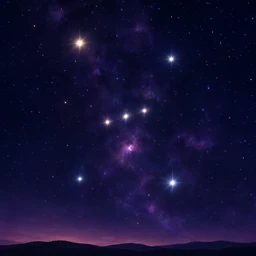 Stars After Dusk
THE OBSERVER’S FIELD BOOK
Start with one bright object. Give your eyes time and use a low screen brightness.
The outside circle is the horizon and the center is straight overhead. Hold the chart as if looking up. East sits left of north on this upward-looking chart. City times are shown beside the UTC controls.
The app reports geometric positions. Twilight, clouds, glare and buildings can hide objects that are mathematically above the horizon. Close to the horizon, refraction can shift the apparent position.
Choose a date and local time, then look for one bright object or one recognisable pattern above your roofline. A map is a prediction of geometry, not a report of cloud or transparency. The observing planner allocates time for orientation, observation and a short record, with a fallback for cloud.
For timing, compare the phase on a date and check its position on the map. For visual reading, inspect the NASA LRO surface model: mapped dark patches are different from the moving boundary of sunlight. The worked field note walks through that comparison.
Locate an object with your eyes first. Use a field-of-view specification to decide whether two targets fit together; it is a geometric width, not a quality score. The field-of-view tool makes this comparison explicit. Never point binoculars at the Sun.
A useful note contains the local time, place, viewing direction and what was actually visible. Keep an unsuccessful observation too: a blocked horizon or cloud gap explains why a mathematically visible target was not seen. Compare notes under similar conditions before drawing a conclusion about your equipment.
Stellar positions and magnitudes use a subset of the HYG star catalog v4.1 by David Nash and contributors, under CC BY-SA 4.0. The chart draws selected cultural stick figures, not the official IAU boundaries. Ephemerides and coordinate transforms use Astronomy Engine. The star subset does not apply individual proper motions.
Three stars form the Hunter’s belt between bright shoulders and feet.
Find it in the map →Four stars make the bowl and three form the curved handle of this pattern in the Great Bear.
Find it in the map →Five stars trace a W or an M, depending on the pattern’s orientation in the sky.
Find it in the map →Acrux and Gacrux mark the long axis of the cross; Mimosa and Imai mark its shorter arm.
Find it in the map →The Northern Cross traces the Swan’s body from Deneb to Albireo, with wings spreading from Sadr.
Find it in the map →A curved sickle outlines the Lion’s head, and a triangle marks its hindquarters.
Find it in the map →A V around Aldebaran marks the Bull’s face, with two lines extending to the horn tips.
Find it in the map →A fan of stars leads to reddish Antares, then a long hooked tail curves up to the stinger.
Find it in the map →