
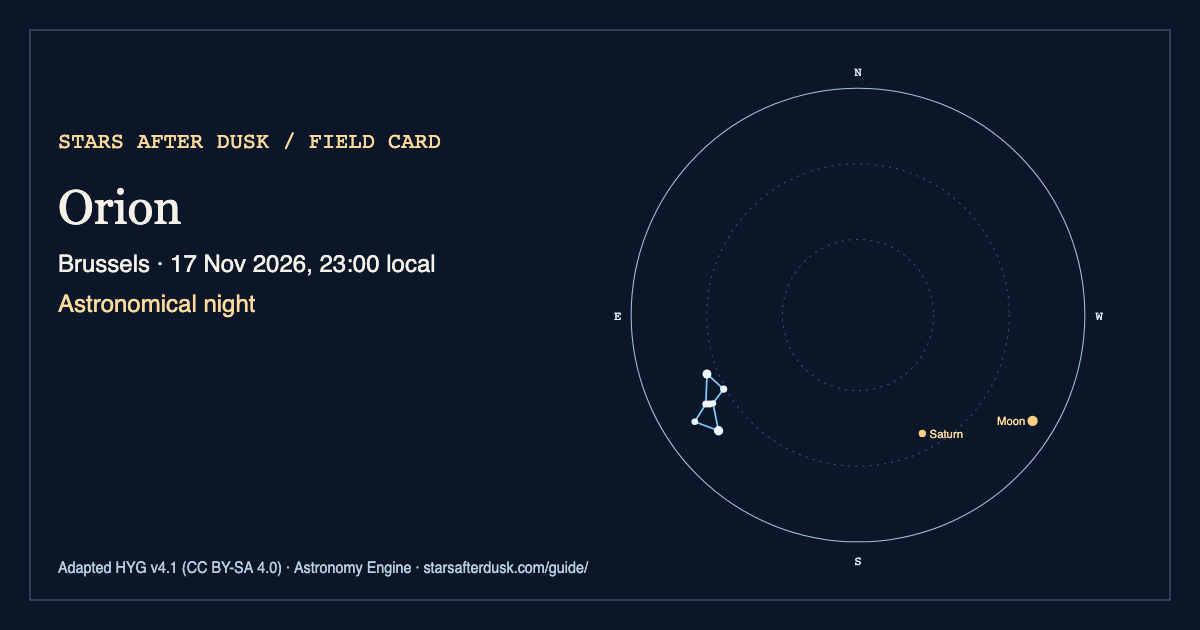
Look for three bright stars spaced close together in an almost straight line. They are Alnitak, Alnilam and Mintaka. Use the rest of Orion to confirm the line: look for reddish Betelgeuse and bright bluish-white Rigel on opposite sides of the belt. The pattern can lean or appear upside down, depending on where and when you look.
Set the map to the sky you will actually see
- Open the sky map, choose your city and set the local date and time you plan to go out.
- Select Orion and look at how high it sits. If the belt is low, buildings, trees or haze may hide it even when the map shows it above the horizon.
- Face the direction shown on the map. First find the three stars with your eyes, then use the wider outline to check your match.
Look for a second landmark
Orion’s Sword is a shorter line extending near the middle of the belt. The fuzzy patch near its middle is the Orion Nebula. From a dark site you may see it without binoculars; from a bright street, finding only the belt and the two bright corner stars is still a good observation.
Orion is prominent on many northern winter evenings. In the Southern Hemisphere the same part of the year is summer, and the pattern appears rotated. Use a date and location rather than relying on a fixed compass direction. The illustration is an example from Brussels, not tonight’s forecast. Data attribution for sky cards is on the sky guide.